Why cat urine is worse than other spills
Cats evolved to waste very little water, so their urine is far more concentrated than a dog's. That concentration is what makes the smell so sharp and so persistent. As it dries, bacteria break it down and release ammonia first, then the stronger sulphur-type compounds that give old cat urine its unmistakable reek. What is left behind in the padding is uric acid in crystal form, which does not dissolve in water and reactivates every time the couch picks up moisture from a humid day, a damp towel or a cleaning attempt.
There is a second problem: to a cat, a spot that smells of urine reads as a toilet. Unless the odour is removed completely, not just masked for you, the cat is likely to return to it, and each repeat pushes more urine deeper into the same cushion.
Step one: find every spot
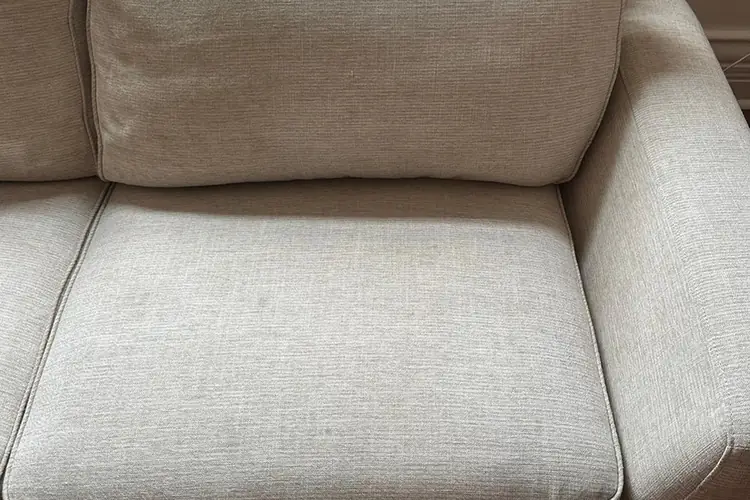
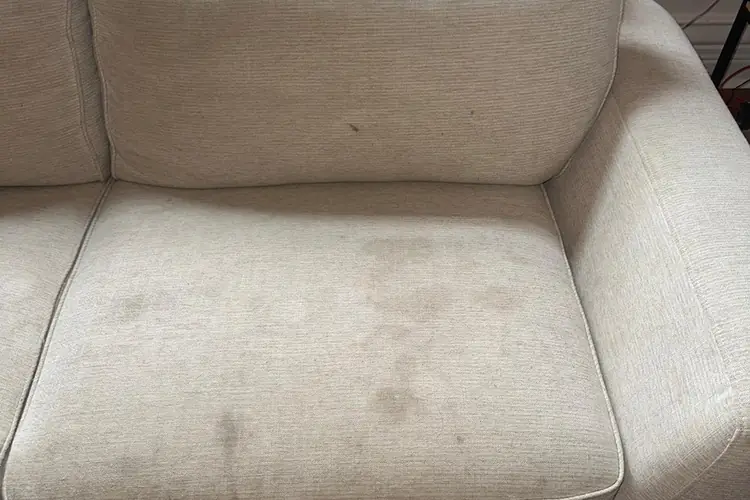
You can only treat what you can find, and cat urine often is not where you think. Cats tend to choose the back of a seat cushion, the corner where the arm meets the seat, or the side of the couch facing away from the room. The fabric may show nothing at all, especially on darker or patterned colours.
- Use your nose, close to the fabric, cushion by cushion. The strongest point is usually the centre of the contamination.
- A cheap UV torch, used in a dark room, makes dried urine glow on most fabrics and shows how far it has spread.
- Check under the seat cushions and on the deck below. Urine that soaks through a cushion often pools on the platform underneath.
- Unzip covers if they come off and look at the insert. A cover can look clean while the foam inside is stained yellow.
What works, and what makes it worse
For a fresh accident: blot, do not rub. Press dry towels into the spot with your weight until no more moisture comes up. Then apply a dedicated enzyme cleaner made for pet urine, generously enough to reach as deep as the urine went, and leave it for the full dwell time on the label before blotting. Enzymes are the only household product that actually breaks down uric acid rather than covering it.
Things to avoid: anything containing ammonia (it smells like urine to the cat), bleach (it can damage fabric and does not remove uric acid), heavy fragrance sprays (they mask the smell for you, not for the cat), and heat. Steam, a hair dryer or a hot iron on fresh cat urine can bond the odour into the fibres and make it far harder to remove later.
Be realistic about DIY limits. A small, fresh accident on a hardy fabric often clears completely. A spot that has been used repeatedly, has reached the foam, or has dried and come back is a different job. You cannot get enough enzyme deep enough without over-wetting a couch you have no way to extract, and over-wetting is exactly what spreads the smell further through the padding.
Stop it happening again
If a cat that has always used the litter tray suddenly starts going on the couch, it is worth a vet visit first. Urinary problems, stress and changes in the household are common causes, and no amount of cleaning will fix a medical issue. Beyond that: keep litter trays very clean (one per cat plus one is the usual rule), cover the treated spot with foil or a throw for a few weeks after cleaning so the habit breaks, and only take the cover off once the smell is completely gone.
When to call a professional
Call us if the smell has returned after cleaning, if more than one cushion is affected, if the urine has reached the foam, or if the couch is a fabric you are nervous about (bouclé, linen, velvet, wool). We treat the padding itself with a professional enzyme process, extract hard so the couch is not left soaking, and are honest on inspection about the hard cases: repeated, long-standing saturation sometimes needs a second treatment, and occasionally an insert is beyond saving. Pet urine and odour treatment is from $40 on top of the published couch price.
Rather have it done properly? We're an Adelaide-wide couch and upholstery cleaning service based in Mawson Lakes — get a free quote or call 0476 112 631, 7 days a week. Published prices, same day most suburbs.